From friend to foe? Examining nutritionally driven shifts in interaction outcomes.
Or, without the jargon: sometimes interactions between species are beneficial (like pollination) and sometimes they’re antagonistic (like predation). Sometimes they change from beneficial to antagonistic, and I examine how an organism’s diet can influence its behavior as a mutualist partner.
I am a PhD student at the University of Arizona, in the Department of Ecology and Evolutionary Biology, where I work with Dr. Anna Dornhaus and Dr. Judie Bronstein. Currently, I work with ant-hemipteran protection mutualisms in the Sonoran Desert, and am venturing into stable isotope ecology. I am a BRIDGES NSF Trainee in Ecosystem Genomics, and am a current 2026-2027 Carson Scholar.
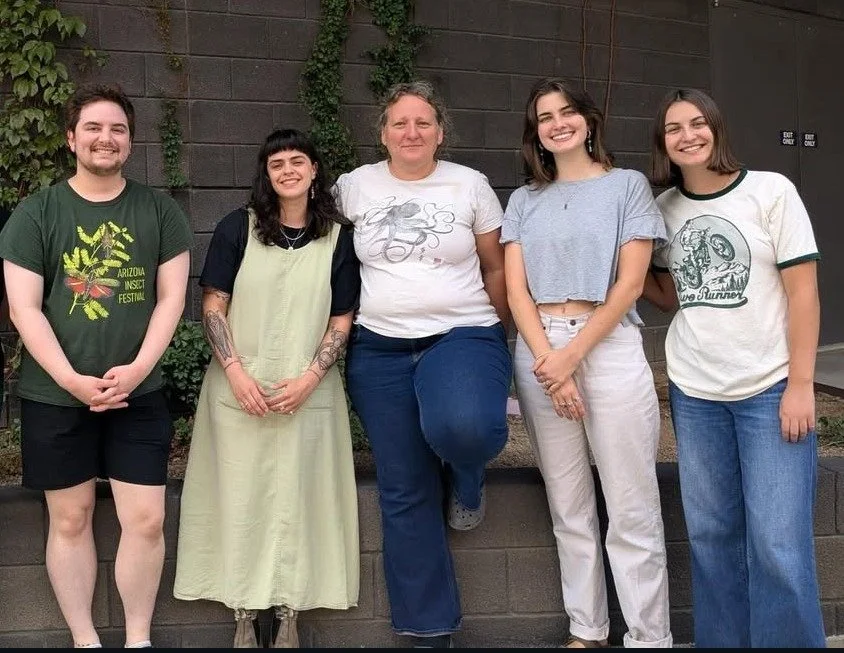
The Dornhaus Lab, 2025
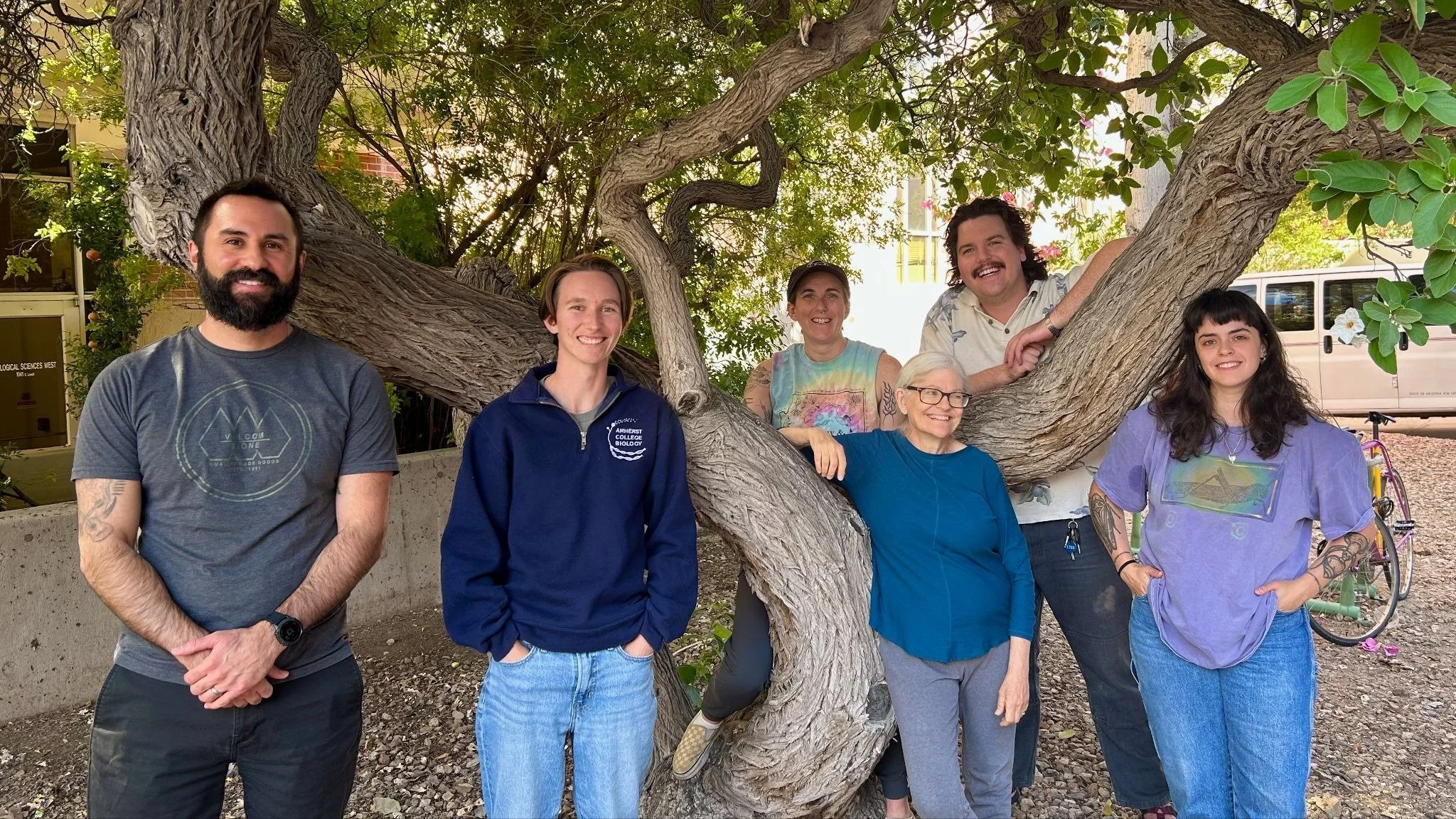
The Bronstein Lab, 2025

My primary research interests
Ant-Hemipteran Interactions
The framing conceptual work of my dissertation, interactions between ants and hemipteran insects range from mutualistic to antagonistic. I seek to understand what triggers these shifts in outcome.
How does resource availability shift interaction outcome?Nutritional Ecology
I am interested in using Stable Isotope Analysis to assess nutrient flow between ants and their hemipteran partners. Hopefully, this will reveal how nutrient availability and partitioning help to shape trophic position.
How do organism's shift their trophic position in response to nutritional availabilityDo myrmecophilous insects exploit nest-level division of labor?Social Insects
The ants I work with are polydomous- meaning they have multiple, spatially segregated, yet socially connected nests. These nests can take many different forms, and host many different creatures (myrmecophiles!).

Publications
Willmott, M., and T. Brosius. 2025. Stitching Science: How Knitting Insects Sparks Curiosity and Conversation. American Entomologist 71:35–37. link
Savage, A. M., M. J. Willmott, P. Moreno‐García, Z. Jagiello, D. Li, A. Malesis, L. S. Miles, C. Román‐Palacios, D. Salazar‐Valenzuela, B. C. Verrelli, K. M. Winchell, M. Alberti, S. Bonilla‐Bedoya, E. Carlen, C. Falvey, L. Johnson, E. Martin, H. Kuzyo, J. Marzluff, J. Munshi‐South, M. Phifer‐Rixey, I. Stadnicki, M. Szulkin, Y. Zhou, and K. M. Gotanda. 2024. Online toolkits for collaborative and inclusive global research in urban evolutionary ecology. Ecology and Evolution 14:e11633. link
Carlen, E. J., A. E. Caizergues, Z. Jagiello, H. Kuzyo, J. Munshi-South, M. Alberti, F. Angeoletto, S. Bonilla-Bedoya, W. Booth, A. Charmantier, J. M. Cocciardi, E. M. Cook, K. M. Gotanda, L. Govaert, L. E. Johnson, D. Li, A. N. Malesis, E. Martin, J. M. Marzluff, M. Mazurek, L. S. Miles, M. Phifer-Rixey, D. Salazar-Valenzuela, A. Savage, R. Snyder, I. Stadnicki, Y. Vergeles, B. C. Verrelli, D. A. Villar, M. Wilhelm-Solomon, M. Willmott, K. M. Winchell, S. S. Yates, Y. Zhou, C. J. Garroway, and M. Szulkin. 2025. Legacy effects of religion, politics and war on urban evolutionary biology. Nature Cities 2:593–602. link